

A website is no good to you if it is unreliable or offline. We have all seen the likes of Facebook or Twitter go down. At Web X Design Studio, we take great strides to keep your website available, and if problems do occur, we aim to fix them before you even notice. This article covers why websites break, and how we monitor and fix things when they do.
Why do websites break?
Your website may run for months or years without a problem, and then suddenly it is down. A bit like a car that drives fine every day until the engine blows.
Hardware failures
Every website runs on a physical server, a computer, but larger and more powerful than the one at home. Most servers have redundant components, so if one disk fails, a duplicate copy takes over. But if the power supply to the server is interrupted, the server, and your website, goes offline regardless of redundancy elsewhere.
Network failures
You might be reading this from home, from work, or on your phone. The server hosting the site sits in a data centre. There are many pieces of ‘string’ between your device and that server, and while networks have plenty of redundant connections, a major interruption can block the path even while the server itself stays online. Workmen accidentally cutting through cables are a classic culprit.
Software issues
Your website is built from many software components, from the server’s operating system through to the plugins that make up the site. All software has bugs. Engineers test as much as they can, but nobody can test every scenario, and some bugs only appear after a specific sequence of events or after a period of time. Any of them can stop a website functioning.
Software updates
You already update the apps on your phone and computer, and generally things stay fine. Occasionally an update goes out that has not been tested against everything else you run, and something breaks. The same applies to a website’s technology stack: updates bring new capability, bug fixes and security fixes, but a plugin developer cannot realistically test every combination of other plugins and software a site might be running.
Maintenance time
Just like a car needs regular servicing, so does the hardware and software behind your website. Most maintenance happens with no interruption, but sometimes a site needs to move between data centres to take advantage of better resources. The good news is this is usually known in advance and can be scheduled for quiet periods.
Security
We have all heard of people hacking into websites, sometimes to highlight a security hole responsibly, sometimes to steal data or take a service offline.
Keeping your website running and available
We do not just hand over a great-looking, functioning website. A lot of work happens in the background to keep it as available as possible. No one can promise 100% uptime, and any company that claims otherwise, in our view, is probably not being honest with you, particularly if their hosting is suspiciously cheap.
Good, modern hosting
We use Stablepoint for hosting. You likely have not heard of them, since they spend their money on rock-solid servers rather than big adverts. All hosting with them carries a 99.9% uptime guarantee, meaning no server should be offline for more than 44 minutes in a 31-day month. In reality, our sites are online pretty much all the time.

Using the right software
We build on WordPress and WooCommerce. WordPress powers more than 40% of all websites, and WooCommerce is the most popular WordPress ecommerce platform. The more widely software is used, the more likely any bugs have already been caught by somebody else.
Keeping your website secure
We will not publish exactly how we secure everything, since that would only help anyone looking to attack our sites, but we take security extremely seriously.
Software updates
We use a centralised portal that tells us when new software updates are available. Updates bring new features, but often bug fixes and security fixes too. We typically update fairly soon after release and then check for issues. Once a vulnerability is public, attackers move quickly to exploit it, so we would rather update sooner than later.
Proactive monitoring
Now you know problems exist, we would rather you never had to think about them. Here is what we run behind the scenes to catch issues early.
Uptime monitoring
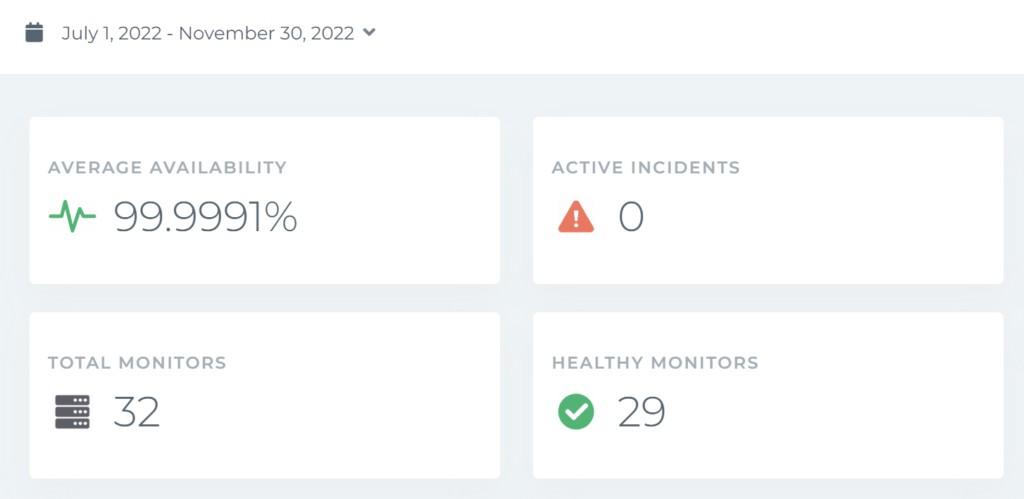
Every site we host is tested for being online once a minute, from multiple UK locations (or close to wherever most of your customers are). The test checks not just that the site responds, but that the right content is showing, by looking for specific keywords, and that it responds in good time. If two tests in a row fail, we are notified by email and WhatsApp. Across the last five months, our hosted sites have been offline for a combined total of around two minutes.
Page display checks
Being online does not always mean a site is working correctly. Every day, software takes a picture of the most important pages on a site and compares it with the previous day’s picture. If there is more than a 5% difference, we are notified and investigate. Most of the time it turns out to be something harmless, like a shop owner adding a new product and shifting everything else along, but it is exactly the kind of change we want eyes on quickly if something has gone properly wrong, including a hacked or defaced page.
Transactional testing
A site can be online and look fine while the things that actually matter, like a contact form or a shop checkout, quietly stop working. For sites where this matters, we run real automated tests that fill in a form or place an order and check the right thing happens afterwards.
Problem resolution
If something does go wrong, there are more ways to fix it than we could list here. The important thing is that we will know about it, and it will usually be resolved before you notice, if you notice at all.
Offsite backups
The last resort is restoring a site to a previously known good state. We take a full backup once a day and store it well away from the data centre hosting the live server. If anything ever happened to that data centre, and it does happen, a backup stored in the same place would be lost along with the site. Keeping backups elsewhere means that even in the worst case, we could have a site back online in a data centre elsewhere within one to two hours.
Conclusion
Websites can go offline or break for all sorts of reasons. What matters is a setup that minimises the chances of it happening, and a way of knowing quickly, and fixing it quickly, if it does. Choosing a web agency is not just about a great-looking site. It is also about who is looking after it day to day. You do not have to have your website built by us to have it hosted and managed by us. If your current site could do with a safer home, get in touch.